Blog
The Role of Dot Phrases in an AI Future
The assumption that AI listening and transcription tools replace documentation shortcuts misunderstands what those shortcuts were actually built for.

The Role of Dot Phrases in an AI Future
AI documentation and transcription has arrived within patient care, and if you believe what you see on the Internet, it's easy to imagine a near-future where you’ll never define note structure again.
Sorry to burst that particular bubble, but documentation templates aren’t going anywhere anytime soon.
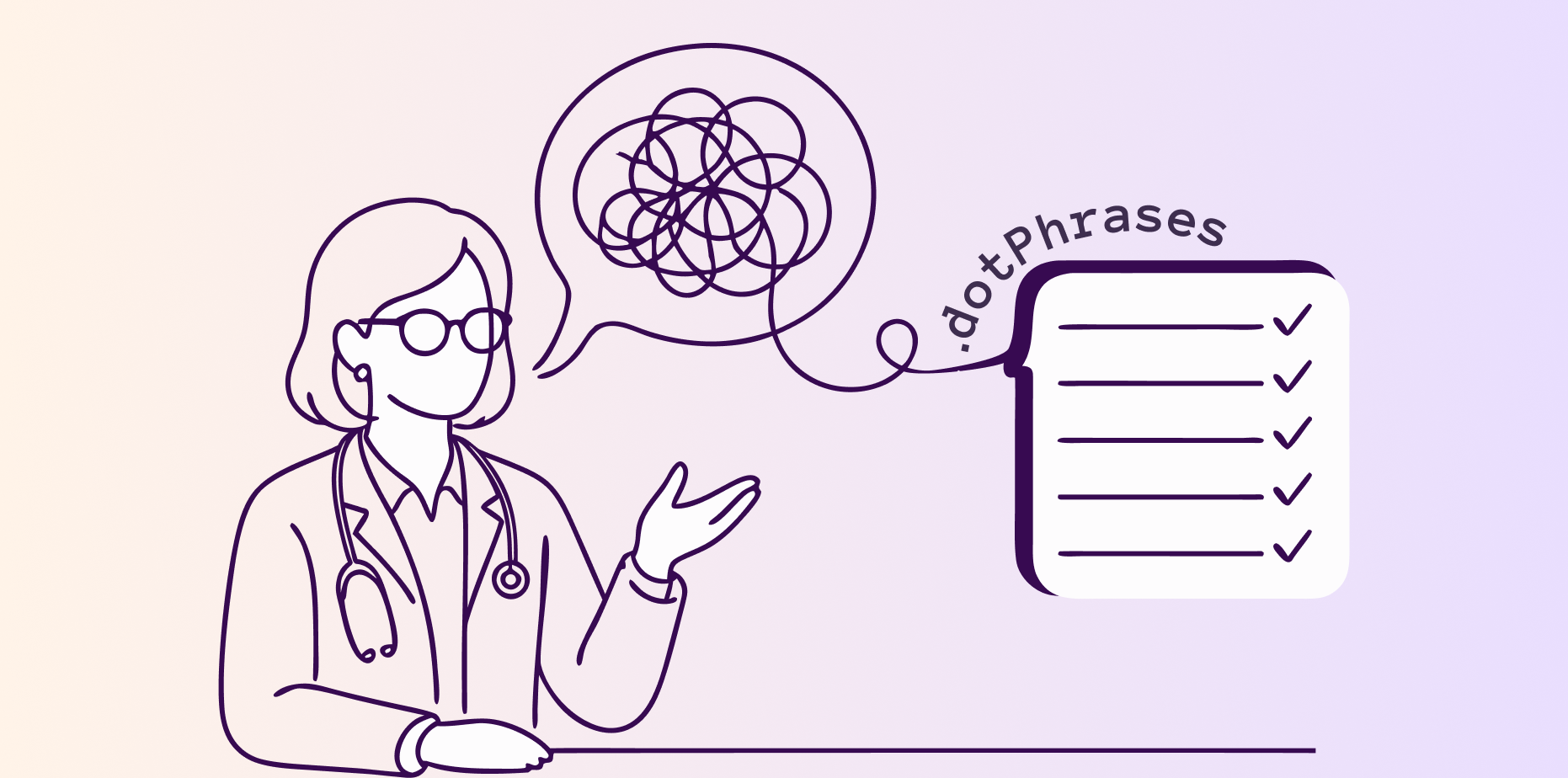
Dot phrases and other tools built for structured documentation are still doing real work in that process. The assumption that ambient listening and transcription tools eliminate the need for documentation tooling misunderstands what those tools were actually built for. Dot phrases were never just a typing shortcut. They exist to standardize how specific clinical content gets captured, so that the same discharge instructions, the same risk disclosures, the same billing-critical language show up consistently—no matter who's writing the note or how it got started.
Ambient tools can listen to a visit and draft a note, but that draft still needs a clinician's eyes on it.
Someone has to review it, edit it, and make sure it says exactly what needs to be said for quality care, patient safety, and accurate billing.
This means dot phrases are far from being replaced. (Though they won’t remain static, either, as seen with OpenEvidence’s DotFlows, an iteration on dot phrases that incorporates natural language.) If anything, dot phrases are repositioning to be the step that turns a good first draft into a finished, compliant note.
And the need for governance doesn't disappear because a note begins as an AI-generated transcript instead of a blank text field. If anything, it becomes more important, because now there's a new starting point that also needs to be checked against the same standards.
That's really the core insight here: Ambient tools are the most visible example of a technology changing how clinicians work day to day, but it hasn't touched what has to happen behind the scenes to keep that work reliable.
There will remain a need for a governed and structured documentation layer. Language still needs to match what a health system's compliance, coding, and quality teams require. Someone still has to be able to answer basic operational questions about the tools generating that language: who's using them, how they're being built, and where they're showing up across the record.
Ambient changed the front end of documentation. It didn't touch the back end at all.
That back end is exactly where the governance gap tends to open up. Dot phrases can be created ad hoc, by whoever needs one in the moment, and they multiply quietly across a health system with little visibility into how consistent or current they actually are. That's a governance problem whether or not Ambient is in the picture, and it doesn't get any smaller as ambient-generated content and dot phrase (or flow!) content start blending into the same notes.
Just like our work with order sets, Phrase Health now gives health systems visibility into their dot phrase environment: which ones are actually in use, how they're being created, and where they're showing up across the record. That's the analysis and governance layer that keeps documentation consistent, safe, and billing-accurate, regardless of what new front end technology clinicians are using to get their notes started.
New tools will continue to change how a note gets written. Phrase Health makes sure what ends up in that note is still something you can stand behind.
The assumption that AI listening and transcription tools replace documentation shortcuts misunderstands what those shortcuts were actually built for.

Written by
Dr. Marc Tobias, MD, FAMIA
Sep 2, 2026
Written by
Dr. Marc Tobias, MD, FAMIA
Sep 2, 2026
AI documentation and transcription has arrived within patient care, and if you believe what you see on the Internet, it's easy to imagine a near-future where you’ll never define note structure again.
Sorry to burst that particular bubble, but documentation templates aren’t going anywhere anytime soon.
Dot phrases and other tools built for structured documentation are still doing real work in that process. The assumption that ambient listening and transcription tools eliminate the need for documentation tooling misunderstands what those tools were actually built for. Dot phrases were never just a typing shortcut. They exist to standardize how specific clinical content gets captured, so that the same discharge instructions, the same risk disclosures, the same billing-critical language show up consistently—no matter who's writing the note or how it got started.
Ambient tools can listen to a visit and draft a note, but that draft still needs a clinician's eyes on it.
Someone has to review it, edit it, and make sure it says exactly what needs to be said for quality care, patient safety, and accurate billing.
This means dot phrases are far from being replaced. (Though they won’t remain static, either, as seen with OpenEvidence’s DotFlows, an iteration on dot phrases that incorporates natural language.) If anything, dot phrases are repositioning to be the step that turns a good first draft into a finished, compliant note.
And the need for governance doesn't disappear because a note begins as an AI-generated transcript instead of a blank text field. If anything, it becomes more important, because now there's a new starting point that also needs to be checked against the same standards.
That's really the core insight here: Ambient tools are the most visible example of a technology changing how clinicians work day to day, but it hasn't touched what has to happen behind the scenes to keep that work reliable.
There will remain a need for a governed and structured documentation layer. Language still needs to match what a health system's compliance, coding, and quality teams require. Someone still has to be able to answer basic operational questions about the tools generating that language: who's using them, how they're being built, and where they're showing up across the record.
Ambient changed the front end of documentation. It didn't touch the back end at all.
That back end is exactly where the governance gap tends to open up. Dot phrases can be created ad hoc, by whoever needs one in the moment, and they multiply quietly across a health system with little visibility into how consistent or current they actually are. That's a governance problem whether or not Ambient is in the picture, and it doesn't get any smaller as ambient-generated content and dot phrase (or flow!) content start blending into the same notes.
Just like our work with order sets, Phrase Health now gives health systems visibility into their dot phrase environment: which ones are actually in use, how they're being created, and where they're showing up across the record. That's the analysis and governance layer that keeps documentation consistent, safe, and billing-accurate, regardless of what new front end technology clinicians are using to get their notes started.
New tools will continue to change how a note gets written. Phrase Health makes sure what ends up in that note is still something you can stand behind.
.svg)
.svg)